• Studies have identified that pigs use more than 20 oinks for different situations and that mother pigs sing to their young while nursing.
• Pigs enjoy music and playing games such as soccer and are big fans of belly rubs.
• When trained, pigs can learn their own names and sit for treats like dogs.
I learned about the smart, social and inquisitive nature of pigs through my research and I absolutely think they deserve recognition for their abilities and personalities. If you think cats and dogs should not be abused, slaughtered and eaten, perhaps you may want to consider giving intelligent farm animals a chance to live a life free of suffering as well. Cows and poultry have their own intelligence and social characteristics too, just look it up!
PETA just came out with 9 fur facts that will make you think twice about the fur in a boutique, in your closet or on someone's body. Sometimes heartbreaking pictures are not good enough, because they don't break everyone's hearts. Hopefully, solid data on the cruel life-to-death fur industry practices will speak to your conscience. If so, please share this information with anyone you know that has purchased any kinds of fur. Let them know fur is not the least bit classy and that ignorance is not the way to go!
Fur Fact 1: Electrocuting fur-bearing animals anally and genitally is an agonizing slaughter method used frequently to limit damage to fur. New York is the only state in which this inhumane method is illegal.
Fur Fact 2: Eighty-five percent of the fur industry's skins come from animals who were captive on fur factory farms,where they are crammed into severely crowded, filthy wire cages and laterskinned alive.
Fur Fact 3: There are no penalties for people who abuse animals on fur farms in China, which is the world's largest fur exporter, supplying more than half of the finished garments in the United States.
Fur Fact 4: One billion rabbits are killed each year so that their fur can be used in clothing or for lures in fly-fishing or trim on craft items.
Fur Fact 5: In China, more than 2 million cats and hundreds of thousands of dogs are bludgeoned, hanged, bled to death, and often skinned alive for their fur.
Fur Fact 6: Fur farms harm the environment. One million pounds of feces are produced annually by U.S. mink farmsalone. One dangerous component of this waste is nearly 1,000 tons of phosphorus, which pollutes nearby rivers and streams.
Fur Fact 7: Fur farms in the U.S. are the only sector of animal agriculture unregulated by the federal government.
Fur Fact 8: After an animal has been slaughtered, his or her skin is treated with toxic chemicals to keep it from rotting and decomposing in the buyer's closet.
Fur Fact 9: One-third of all fur sold in the U.S. comes from animals killed in steel-jaw traps, which are legal in 43 states. These traps slam shut on an animal's limb, which causes excruciating pain and leaves the animal stuck and starving, sometimes for days. The conibear trap crushes an animal's neck by applying 90 pounds of pressure per square inch, leaving the animal to suffer for another three to eight minutes while he or she slowly suffocates.
As reported by The Washington Post: "A study by Science/AAAS shows that rats preferred freeing caged rats rather than eating food placed in the cage, suggesting that the rats show empathy, a trait only previously known to primates. (Courtesy of Science/AAAS)" (source)
In the video, you can see the rat trying to find a way to free the other rat trapped in a bottle. The video mentions that rats choose to first save the trapped rat before even touching the provided food and even ended up sharing the food with the other rat. I haven't had personal encounters with rats, but I have released two mice into parks on separate occasions after noticing that my cat was playing with them.. the mice are really no different than your other small "pet" animals (hamsters, guinea pigs, rabbits) who are inquisitive and try to live a safe and happy life.
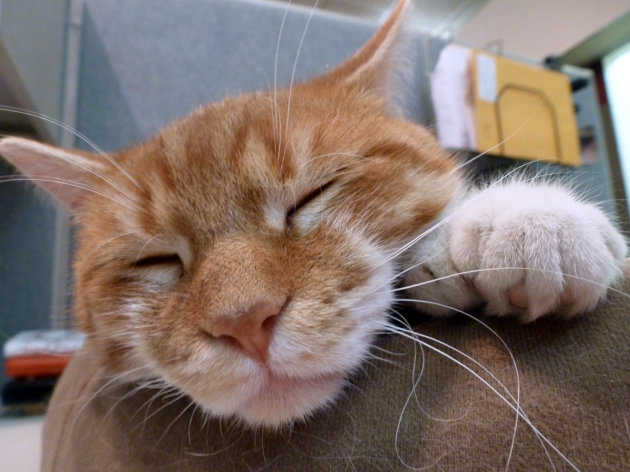
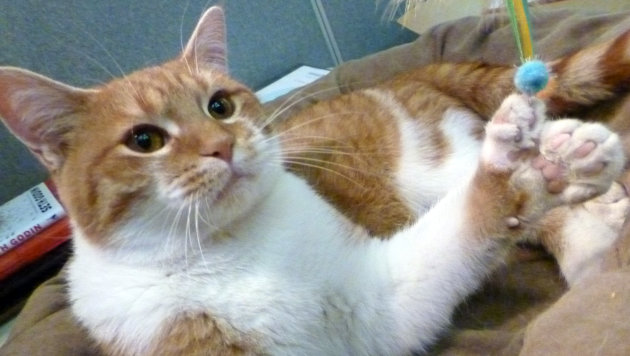
This cute white and orange tabby named Daniel has 26 toes (8 more toes than an average cat), and every one of those toes came into use when Milwaukee Animal Rescue Center found themselves short of financing to continue their operations due to a doubling in rent. Daniel's special toes helped raise more than $50,000 at the shelter as the shelter asked for $26 donations, $1 per toe. Daniel was once an unwanted cat at another animal control that might have been put to sleep, but now he is one loved mascot at the Milwaukee center. (full article here)
Our animal friends really do bring us unexpected blessings, if only we would do more for them so that no unwanted animals would have to die.
"All that is necessary for the triumph of evil is that good men do nothing."- Edmund Burke (cite)
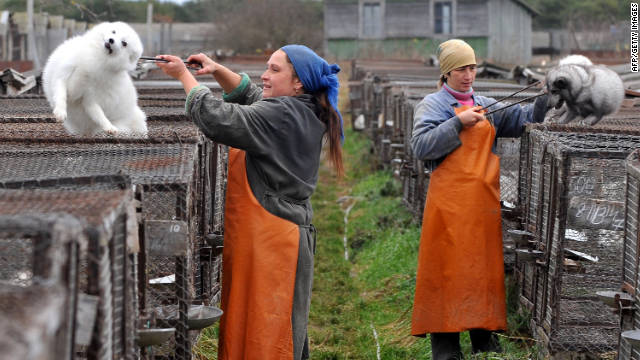
Two workers handle foxes at a farm in Russia, one of the countries with fur farms that supply fur to the "fashion" industry.
West Hollywood, California, one of the fashion hubs of the state, has recently passed a ban on the sale of fur in the city- making it the first city in the nation to take such a step. The ban will officially be enforced in 2013. There are various opinions on this ban, of course some are thrilled and some not so much. Whatever people make of this, I say that a step against cruelty and exploitation is a step in the right direction.
This clip is short but notable. Jilian Michaels, the trainer from the show The Biggest Loswer, stepped up and publicly spoke against animal suffering in the circus.
If you do not already know why going to circuses equates to supporting pure cruelty to animals, take one minute and visit www.ringlingbeatsanimals.com If you are someone that thinks animal abuse is wrong, you will definitely be able to see that circuses do not support your values. Please share the word and, as JilianMichaels said, make this viral so that everyone will be informed and make their own educated decisions.
Tonight I came across a video titled "I am scared and don't want to die." It was a secretly filmed segment of one cow's last few minutes of life. The cow knew of its fate behind the door of the slaughterhouse and very obviously did not want to go in for fear of impending death.
Our society is very far removed from the animals that we consume, whether in the form of meat, leather, or dairy products. It was not always this way, but as countries became more industrialized and focused on mass production, efficiency, and profit in the past few centuries, they also lost their connection with animals as they moved out of the agricultural and farming lifestyles. As the meat industry expanded along with capitalism, so did the forced breeding and killing of animals. As objects of investment, the animals' natural needs and wants became disregarded and secondary to what would make the most money for those running the meat business.
This led to maximizing the number of animals kept within a certain area of space and thus inhumane, overcrowded quarters for chickens, turkeys, cows, and pigs. A lifetime of confinement in filthy, tiny cement stalls of farm factories is, to say the least, unnatural. This also led to feeding the animals unnatural foods including antibiotic and growth hormones to rapidly increase body mass and shorten the period between life to slaughter, again for the purpose of obtaining more profit per animal. Unnatural feeding not only harms animals and leaves them crippled and disabled due to the disproportionate weight of their bodies, but its consequences have also shown itself through the public health (for example through the rapidly increasing rate of weight gain and early age of menarche for young girls due to high level of estrogen).
Furthermore, the treatment of farm animals as objects of investment led to the most cheap yet most cruel methods of raising and killing animals. Aside from "living spaces" that often leave no room for animals to turn around, equivalent to a human living in something smaller and narrower than a public bathroom stall, other cruel methods include surgical procedures aimed to reduce fatality in the farm, which are often performed without anesthesia. Piglets have their tails docked off with scissors to prevent other pigs from chewing on them, a behavior due to stress. Baby chicks have their beaks seared off with a hot iron machine to prevent pecking and injuring other birds, which is again a behavior caused by stress. These are but a few examples of how our farm animals suffer a lifetime of invasive and forced procedures aimed to protect their value as products.
The final strike of our mistreatment of farm animals ends with their murder, which I need not go into detail here- all you need to know is that this kind of slaughterhouse murder would be punishable by law if it occurs to any human being or pet animal in many countries. Finally, the manipulation of the consumer market, which limits consumer knowledge, and promotion of meat and animals products through sales strategies and marketing by the meat industry is another issue that contributes to farm animal cruelty- however, it is a topic for another day.
We humans have unnaturally caused the existence and also suffering of hundreds of millions of animals through artificial insemination (or forced breeding) and cruel methods of farming all tailored towards human benefit. That is selfishness and a disrespect to the gift of sentient animals provided by the earth. The video that I posted above of the frightened cow refusing to enter the slaughterhouse is a perfect illustration of what I mean by sentience. You may take this with a grain of salt, but I have heard from others that cows not only cry (with tears in their eyes) but also talk as if they were begging for their lives when they realize they are meeting their end.
Furthermore, our farm animals share a similar basic nervous system with us and our pet cats and dogs and other mammals, which means they can think, feel, understand and plan. Although their cognitive abilities are relatively limited when compared to humans, there is no factor that will be good enough reason enough to condemn them to (for lack of better terms) a life of hell.. unless you believe that infants or mentally disabled people of less developed cognition deserve less than a fair chance at life and personal happiness. People who have interacted with animals know that cats, dogs, cows, chickens, and pigs are social animals that share close bonds with their companions and hold the capacity to feel pain, suffering, and happiness.
Before I end this note, I want to touch on one more thing. Where does this "value" (that I mentioned three paragraphs ago) for animal meat come from? The economic value of something is determined by what a consumer is willing to pay for a product, thus how much profit a company can reap through the production of something. It can be influenced but is not ultimately decided by the supply or corporate end of the market. Instead, it is decided by the choices of those with purchasing power- both you and I.
This post is based on my understanding and research over the last few years of the present day meat industry. It is a simplified overview of the development, nature, injustices and tragedies of our farm factories where innocent souls are brutally mistreated by the hundreds of millions. Modern farm factory practices are truly an atrocity for the disadvantaged whose voices and lives are sealed behind slaughterhouse doors.
If you have any thoughts, questions or feedback for me at all, please comment below- an Google account is not required.
The commonly known figures are 6 to 8 million for animals taken to shelters every year and about 4 million for animals that are euthanized at these shelters. When numbers get so large (above hundreds, thousands, millions) that we can't wrap our minds around them, a number merely remains a number and there is no impact on us. But what if you could see everyday a few of the faces of the cats and dogs whose lives will be purposefully ended because no one has come their way to save them?
What if I told you that this one year old dog named Trudy will be put down in Texas TOMORROW if no one decides to take her in?
What if I told you this 7 months old girl will be killed within hours, TODAY, in Las Vegas?
What if I told you this 7 months old kitty was already put down today..
..as well as this two years old female named Faith?
There is the most thoughtful application on Facebook called "Pet Pardons" that allows people across the states to post up information on animals in shelters whose lives have a decided timeline: http://apps.facebook.com/petpardons/
If you have a Facebook account, this is one of the best thing you can do for animals truly in need. Simply add the application and share postings with your social networks. If you know of any animals that will be put down at a shelter, this is also one of the places to spread the word and get help for the animal.
I will leave you with two more tidbits of information.
For those that have found an animal, please refer to the lists of NO-KILL animal shelters for each state via http://www.nokillnetwork.org/
Also, if you are a pet owner or guardian, please consider neutering and spaying your pet. If you are an animal lover, I know you would want other animals to get the same chance at life as your pet. Always remember, what if your pet was in the position of being an unwanted animal in a shelter because there are not enough homes for all the animals out there?
Edit: And just as importantly, please choose to adopt and save a life rather than buy.
Tonight I came across an article with an article of Ruby Roth, the author of the children's book That's Why We Don't Eat Animals. I found myself thinking that this woman has created the perfect book to lay down the truth about meat in a manner highly appropriate and suitable for children, while maintaining educational value. To see the article visit here: http://www.care2.com/causes/should-kids-know-where-meat-comes-from.html
This book is full of hand-illustrated graphics that explain farm factories, the lives of farm animals, and the consequences eating meat has on these poor animals as well as the overall environment. It is truly something I would consider reading to my future children so that they will grow up with an understanding of the meat industry and the sentience of animals. (However, the decision will ultimately be their own.) Here is an accompanying introductory video to this book that touched me because children are really true to their instincts about what they feel is right:
Just something to share with anyone wanting the children in their life to have the ability to make decisions regarding consuming animal lives.
I'm sure most of you know about one of the newest movies in theaters right now: Planet of the Apes. While production crew did not use real apes in the making (fortunately), the movie shows how cruel and sad it is for primates that are locked up in small cages for experiments. Theses animals who share 99% of our DNA are intelligent and share similar needs and emotions for us. They need socialization, fresh air, and natural lives just as much as we need love from others and our own will to do what we want. These primates suffer post-traumatic stress disorder and depression from living such miserable lives, just like we would in their position. Luckily for us, there is no higher and more powerful being that is sadistic enough to stuff us in cages 24/7, cut us up or probe us for their research and then toss us back into the cage when we are not being used. So who are we to take what (or who) we want for our own purposes while neglecting the basic needs of our primate cousins?
Sometimes experiments can be conducted humanely- however, as many animal welfare organisations have found, animals in labs are more often than not treated as lab objects- something you can cut up or inject chemicals into, something you can toss back into a cage until your next experiment. Their lives look a little something like this:
Furthermore, we are the last industrialized nation that continues to perform invasive operations on great apes, even when we know primates do not develop HIV or other diseases like Hepatitis C like humans do.
Whether it be chimpanzees, apes, or any other kinds of animals being used in experimental lab testing, more and more evidence is being found that the physiological effects of chemicals and substances do not manifest in the same for us humans as it is for other species- in other words, animal testing is unnecessary, ineffective, and inaccurate (and perhaps even an obsolete method of testing) for "health and medicine" purposes.
There is a Great Ape Protection and Cost Savings Act that needs your support: please visit here and here to find out more.
Don't forget, other animals used for fur suffer similar if not worse fates. Also, those who support cruelty to animals for unnecessary and unreasonable purposes really are not animal lovers- having pets does not count either.
You might have seen the title phrase above through animal compassion campaigns by Mercy For Animals.
This isn't just an ad, it's a nudge towards re-evaluating our core values because our beloved pet animals are inherently no different than the intelligent and social farm animals that suffer needlessly for our food choices. A new video (less than 3 minutes in length) uploaded by Mercy For Animals gives us a reason to stop, think, and hopefully make compassionate choices for these pigs that are abused beyond belief, just because we choose to eat pigs but not dogs when the lives of both are equally valuable.
USDA has come out with a new food guide in the form of the icon below. All information regarding these new dietary recommendations can be found here: http://www.choosemyplate.gov/ At the website you can click on one of the five components to find out what foods fall into each category. The USDA lists the following non-meat options to fulfill the protein category (source):
Beans and peas
black beans
black-eyed peas
chickpeas (garbanzo beans)
falafel kidney beans
lentils
lima beans (mature)
navy beans pinto beans
soy beans
split peas
Processed soy products:
tofu (bean curd made from
soybeans)
white beans
bean burgers
veggie burgers
tempeh
texturized vegetable
protein (TVP)
PCRM's new article on the food plate brings up the point that USDA's modified food icon is at opposition with federal subsidies for meat and diary. PCRM (Physicians Committee for Responsible Medicine) states that currently over 60 percent of agricultural subsidies have instead supported meat and diary production, leaving only 1 percent to go towards fruits and vegetables. The USDA is advising people to take on a healthier diet with less fat content, and I wonder if it knows its suggestions clash with the federal government subsidies which give billions of tax money to the meat and diary industries.
PCRM also has a food guide that can be found here: http://pcrm.org/health/powerplate/ It is resemblant of the new USDA power plate and has "proteins" replaced with "legumes, definitely for good reason as about 68% of Americans are obese or overweight. According to the same PCRM article, more than 60 perecent of the deaths in the U.S. are caused by heart disease and other diet-related diseases. The PCRM power plate is also interactive, so feel free to click on the portions to find out how to best balance your diet!
If you have fallen for any of the myths below, I highly recommend you check out this article that breaks each item down for you. To be honest, I haven't really thought about #4 or #5 and I am still apprehensive about #1 (for multiple reasons that I will discuss someday). #2 is the one that I was already certain of, because I recently explained to a friend why I would eat plants and not meat since plants are also living things. I definitely draw the line based on a being's physiological and biological traits which would allow it to have perception, awareness, feelings, and a capacity for pain.
1. Myth: You need to eat meat to be healthy.
2. Myth: Plants feel pain too.
3. Myth: Vegan foods are expensive.
4. Myth: They're destroying the rain forests to make tofu.
All photos and captions below are from JEAR's (Japan Earthquake Animal Rescue and Support) facebook page: http://www.facebook.com/AnimalRescueJapan These photos remind us why we need to support animal rescue groups and continue to send our thoughts to the Japanese government regarding the evacuation of animals left behind.
"After reading a leaflet left by volunteers near their evacuated home in Fukushima, Moko's family hoped against hope that their dog was one of the lucky rescues. “I never thought we'd see her again,” said the mother of the family through her tears. As joyful a reunion as one could hope, Moko, a fluffy and cheerful brown and white mixed breed, greeted her family enthusiastically when they arrived at Animal Garden, Niigata, on May 2nd to take her home with them. /Joan"
This woman shared her concerns with us about evacuating from her home in the 30km zone. She said she would stay as long as possible, and imagined that she could take her cat with her when the time came to leave. She worried that her large-sized dog, however, might be a different story. She agreed to contact us for help when evacuation is imminent, and before we said goodbye we left her with some food for both pets.
These cats were left behind when someone evacuated. All three are at the Animal Friends Niigata shelter now. It is difficult to see from the photo, but the kitty closest to Susan was the most severely emaciated, and is the one we are most concerned about. After this photo was taken, she gobbled up several packets of wet food, so I have hope that she is a fighter and can recover. A vet was on hand for her arrival at the shelter, and she received immediate medical attention.
"Dennis, a Kinship Circle colleague, at a small dairy farm near the border of the 20km zone; this was the team's second visit to offer what help we could. This family-owned farm is doing the best they can with limited resources, and someone has stayed behind to care for the cows. We spoke with one of the sons, who wanted people to know that each of the cows is deeply cared about, and he does not want them to suffer. /jh"
"As we were driving through an abandoned area around Fukushima we saw a dog wandering down the street. Unsure of where he was headed we slowed down and stopped. He glanced over at us and continued on his way. We were close enough to notice a cut over his swollen eye and the scratches on his nose. His fur was also scuffed and the skin looked raw underneath. As we stopped and got out of the van he turned around and approached us, not in the least wary. After giving him some food and noticing that the vicinity was completely empty we leashed him and he jumped excitedly in the van. We named him Benji. Now we are all on our way to the shelter."
"One of our volunteers feeding a very hungry kitty that the team rescued in Fukushima."
Last November I wrote a post about glue traps that was based on my personal views and experience. You can see my story about the little mouse I set free here: Humane Mouse Traps & My Personal Story.
What I left out is how extremely inhumane these devices are, for they literally fuse an animal's body on to the thick, sticky substance and upon immobilizing the animal, they leave the animal to die a slow, painful death either as their body deteriorates and weakens.
PETA, on their facebook page, posted this photo: "Glue traps are (obviously) indiscriminate and ensnare any animals who are unfortunate enough to wander across their path. If you know of any local businesses, schools, or property management companies that are using glue traps, urge them remove the traps immediately and contact PETA if they won't. http://bit.ly/iy20lp"
The bird that you see here hopefully immediately lights the notion of how cruel glue traps really are, whether or not they adhere non-targeted animals birds, kittens, squirrels, and hamsters or "targeted" animals like mice. The story behind the photo is that there were two songbirds stuck to a glue trap in a Walmart store in Indiana, and customers took action to take the birds to a wildlife rehabilitator as well as contact PETA. Walmart in reply stated that it had only meant to set the traps for rodents, but glue traps obviously have no mercy for anything that gets in its way. According to PETA, a variety of many animals die in glue traps every year-- a kitten in Boston almost starved to death in this fashion. You can see the kitten story here.
Here are some facts that blew me away today (although I did know a few). Tell me- how many of these do YOU know?
Btw, these facts were playing on a slideshow that I could not pause, so I typed furiously away and repeated them until I could catch every word! All credits to PETA2: http://ht.ly/4K5JO. Photo credit: http://www.animalrescuesoc.org/
Each time an animal is bought from a breeder or pet store, an animal in a shelter loses a home.
Pet shops acquire most of the puppies they sell from puppy mills.
About 25% of dogs dropped off at shelters are purebred.
Many "no kill" shelters are, in reality, "slow kill" shelters.
Kittens and puppies can be spayed or neutered as young as 8 weeks old.
Neutering makes male animals less likely to roam or fight, prevents testicular caner, and reduces the risk of prostate cancer.
Areas with mandatory spay-and-neuter laws have reported a significant reduction in the number of animals who are taken to their facilities and subsequently euthanized.
Every year, 6 to 8 million unwanted dogs and cats enter U.S. animal shelters
8 million unwanted dogs and cats = the population of New York City or Switzerland
Nearly half of all dogs and cats entering U.S. shelters ever year (3-4 million) are euthanized because there are not enough homes for them.
In U.S. shelters, more than 900 animals are euthanized every hour-- that's more than 10,000 animals a day.
Approximately 70,000 puppies and kittens are born in the U.S. each day.
In only six years, one unaltered female dog and her offspring can produce 67,000 puppies.
In only seven years, one unaltered female cat and her offspring can produce 420,000 kittens.
It is estimated that between 30 and 40 million homeless (feral) cats live in the U.S.
You might be aware that the government of Japan has set a policy that prohibits entry of the Nukushima Nuclear Power Station within a 20km radius. This is to protect people from radiation, but the problem is that there is an estimated 5,000 to 10,000 domestic animals still left behind in this zone. The no-go zone has been enforced since April 27, 2011, which is seven days ago. This means it has been seven days since many animals have received any food or care by local citizens and rescue groups. There are many willing individuals and organizations that want to go in and rescue the animals NOW before it is too late.
The video above will give you a rundown on the situation and show you exactly why we, people all over the world, need to step in and help. I'm sure many of you would agree that animals are like our family and children. It brought tears to my eyes to see the misery of the animals left behind in Fukushima- you can see their dampened spirits in their saddened eyes and their emaciated bodies. In the video, you can see pets staying loyally at their homes, waiting for their families to return.
JEARS (Japan Earthquake Animal Rescue and Support) is one group that is actively pursuing efforts to save as many animals as possible. You can follow their facebook page to keep updated on the status of their rescue efforts. Here is a photo from their facebook shared by one of their volunteers with the following caption:
"This kitty seemed to be waiting for someone to come home. When she realized that I was really there, she literally ran up to me and jumped into my arms! I am so glad that I was combing this particular area for kitties, as the house was set back from the road and we may never have seen her. She is emaciated and suffering from an upper respiratory infection, but ate non-stop after joining me on my lap in the van; she is now receiving medical attention at the shelter in Niigata."
If you feel impelled to help, as I am, there is one direct and immediate way to reach the Japanese prime minister's office. You can send them a message to save pets in the exclusion zone through this page: https://www.kantei.go.jp/foreign/forms/comment_ssl.html
This is my brief but straighforward message to them:
In all due respect, I am a graduate student from the U.S. and have heard that there are thousands of animals that are suffering in Fukushima. Animals are our children and family, and I am disappointed that their lives are being treated with less regard as they are being left behind due to the 20km policy. My heart is breaking as I know it has been one week since many of them have had any food. Please allow willing local citizens and rescue groups to save the beloved pets of your nation in one mass effort before it is too late. Thank you.